30 Deep Philosophical Questions - Highly thought-provoking questions.

via: Unsplash / Karl Fredrickson
Philosophical questions are those uniquely interesting, thought-provoking questions, that really brand you think deeply... and often get harder the more you lot call back nearly them.
Philosophy(the report of ideas... near knowledge, truth, nature and meaning) is i of the oldest-good sciences in human history.
...And that'due south because philosophy questions like where did we come from, what is the significant of life, and how does our universe piece of work are deeply embedded in ourhuman curiosity. Think about it:
Our desire for significant and knowledge fuels us to larn, to get ahead, and to become amend people, right? That's why request philosophical questions is soincredibly of import for people to do... it powerfully helps to fuel your desire to learnalmost yourself, humanity, and the universe.
I've gathered 30 of those deep philosophy questions to ask, below, and written a brief description of each ane. Those descriptions are meant to jump-beginning your thinking about them… just then yous tin utilise your new thoughts in any way you similar: to outset conversations with friends, to periodical almost, or simply to meditate and expand your mind.
Contents
three Deep Philosophical Questions

via: Pexels /
Nathan Cowley
The best philosophical chat topics are based on experiences that are shared by anybody. Whatever of these deep conversation topics can open up up a conversation, to help create a more genuine connection with the person you lot're talking to.
Here are iii deep philosophical questions:
1. Practice people have free will?
"Fate" versus "free will" is a archetype debate in philosophy. How much practice we make our own choices, and how much is already laid out for u.s.a. every bit soon every bit nosotros are born? People will usually feel very strongly 1 way or the other virtually this topic.
2. Is beauty objective or subjective?
What is beauty? If I consider something to be beautiful, it may not guarantee that you will find it to be the same. But is there adeeper beauty that anybody can agree upon, or a class that is inherently beautiful?

via: Unsplash / Brooke Cagle
3. Is nature moving towards dissolution, or integration?
Modern, Western scientific thought holds that all things motility towards greater entropy – failing into disorder. However, ancient Eastern philosophies fence that nature is cyclical, and will both motion towards disorder and greater order. More personally, the question is asked: Are humans better at creating, or destroying?
five Philosophical Conversation Starters
If you're interested in having a conversation about philosophy, it's best to lead with deep conversation starters to motion the conversation in the right direction from the start. Past choosing chat starters with a philosophical content, you lot can determine early and hands, whether your conversation partner wants to have a deeper chat or a shallower one.
Here are 5 bully philosophical conversation starters:
4. What Gives Life Its Meaning?
To answer this thought provoking question, you first accept to decide if life has significant.
...So is life a random occurrence in the universe, and consciousness just an evolutionary quirk that means nix? If that's what you believe, the answer to this question is easy: goose egg.
Merely if youbelieve that life isn't random, and our consciousness has a central purpose in the universe, and then what gives life its meaning?
5. Is it fourth dimension? Is information technology the condition and fulfillment of your soul? Is it death?
Or is there no meaning to anyone's life at first… instead, do yous have to create your ain meaning?

via: Pexels / Pixabay
…Look, hither'south the matter with this question:
No thing what yous think gives life its significant, you're defining all life in the universe by that scale. Is all life equally meaningful by your scale?
six. What Are the Universal Human Rights?
What this question is actually asking is what does every human in the world deserve?
Are all humans guaranteed life, and that'south it?
Or does it get further than that? Practise all humans also deserve liberty, and/or property?
Maybe every innocent man deserves those things... just what virtually murderers? They probably don't deserve the freedom that an innocent person does… do they deserve justice?
…And if every human in the globe deserves justice, and nothing more, then it's fair to say that humans decide their own rights with their choices.
So, if I decide to never murder, steal, or impairment any person in any way, practice I take the right to a better life, free of penalization, than someone who fabricated decisions to harm?
It's a complicated philosophy question (and plain, has many follow-upwards questions), but information technology's an interesting do to endeavour to make a list of what every human has a right to. Is it only justice, like I explained above? Or is it liberty, holding, peace, make clean surround, or happiness? Or is information technology nothing?
7. What is a fair society?
The word 'off-white' tin actually be broken down into two categories:
Equal and just . source
Now:
An equal society is just what is sounds like… everyone has the aforementioned everything (wealth, health, punishments, rewards).
…And a only lodge is one where everyone has what they deserve: hard piece of work means more wealth, better habits hateful better wellness, and wrongful deportment event in punishment.
See the difference?
The problem is that people define 'fair' differently when they talk virtually a fair order… and different people value equality and justice at different levels.
So, what society would you live in? Practice you lot value equality, and want to protect every homo'south rights, or practice you believe that justice is the just human right that matters?

via: Pexels / Daan Stevens
8. Why Do We Create Fine art?
This is a smashing, and surprisingly thought provoking question:
Fine art in any form (paintings, sculptures, theater, music, structure) is something that almost all humans enjoy.
...But even though art has existed for thousands of years, our ancestors certainly weren't artists to survive... they were hunters, gatherers, fishers, etc.
So... since art doesn't help anyone who's non a professional artist to survive, why do we create it?
Humans actually become a step further than just creating art… we've applied artistic principles to things like sex, cooking, and movement. Things that are simply supposed to proceed our species alive have now become 'art forms' (for example, instead of eating whatsoever we can find, we spend a ton of try to create a delicious, beautiful repast).
So, nosotros definitely have a desire to savour and create art, but why? Aristotle idea that happiness was the purpose of life, and that art (both enjoying and creating it) was an attempt to reach that goal. source
…And that suggests that enjoying the dazzler (in nature or in fine art) is an innate desire of humans. We all want happiness, and beauty and art make us happy. source
But... why are we the only creatures on the earth that create art, and not only merely survive? Why does the source of our happiness lie in our creation, and not simply in the earth that already exists (outside our creation)?
The 5 All-time Philosophical Questions To Ask
One time yous've entered into a conversation with the assist of our philosophical conversation starters, you can transition into some of these, our choices for the best philosophical questions. These questions accept sparked intelligent chat for hundreds of years, and are but equally relevant today as they were at the time of Aristotle.
Here are the v all-time philosophical questions to inquire:
ix. Does Fourth dimension Accept a Beginning or an End?
This is question thatreallymakes you recall:
Humans know a lot of facts nearly time, generally due to studies testing Einstein'due south theory of full general relativity… similar that space and time are actually continued in the 'fabric' of infinite-time (that tin can be warped by gravity, etc. I highly suggest you click the link to learn about Einstein'southward theory, if you don't know about information technology already).
…But I'grand not request what we know or can even measure about time. I'one thousand asking what we specifically can't know: did fourth dimension 'brainstorm'?
We have a pretty good idea (backed by some strong evidence) that the space-time fabric of our universe violently burst into existence about 13.8 billion years agone. But what about before and then?
If all the universe was condensed into a tiny dot (or didn't exist at all), was at that place a time? In other words, since space-fourth dimension is a woven textile, can time exist without space?
…And the philosophical question actually gets deeper:
What about the 'end' of time? Will the universe proceed changing, or does time 'stop' at some point? What happens to life when/if it does?

via: Pexels / Monoar Rahman
10. Can People Modify?
Now… it's obvious that people change in some ways: they grow physically, their brains mature and develop, and people even claim to 'change their minds' about certain things.
…Simply if you don't count physical growth and maturity as 'people changing' (since these things are the brain and torso changing, in a way without consent of the person), do people's minds/souls ever change?
Now I know what you lot're thinking: 'Of class! I change my mind about things all the time.'
Merely (and comport with me here)… practise yous really? Or does your highly efficient encephalon merely recognize higher logic?
Take this example:
A woman and her husband make it a fight over where to spend Thanksgiving vacation. At first, she argues to spend it with her family… just past the finish, she decides that since her husband's sis is very sick, they should spend Thanksgiving with her. She tells her husband she'south 'inverse her heed' about spending Thanksgiving with her family unit.
Now:
The question is, did she change her mind, or did she just recognize that it'due south more than logical to spend fourth dimension with his family this year?
…And at present permit'southward make these examples more personal:
Do you 'modify' to become more than courageous, or practise circumstances force you to see that courage is the logical way to face fear? And exercise you 'change' to cease liking an one-time hobby, or did yous realize it's non logical to keep it?
Basically, exercise you ever actually change, or are you just reacting to circumstances logically?
11. Is Our Universe 'Real'?
Some forward-thinking scientists, like Elon Musk, have argued that an advanced culture could create a simulationand then advanced that the simulated 'life' inside it could gain consciousness… and that this has actually already happened (and we're inside the simulation… similar in the Matrix).
Musk's theory goes like this:
Basically, if you assume any rate of improvement on our electric current virtual reality (and our virtual reality is getting pretty damn real), nosotros'll reach a point where virtual realities will be indistinguishable from actual reality.
At present:
Others debate that Musk's theory has some flaws. They say that if something similar an apple was so far imitation that it really fed those in it, the apple isn't even a simulation anymore… it'south existent.
And so so what is reality? Are we in a simulation so perfect that we can't even detect it… and so, if our simulation is just similar reality in every manner, isn't this just another reality?
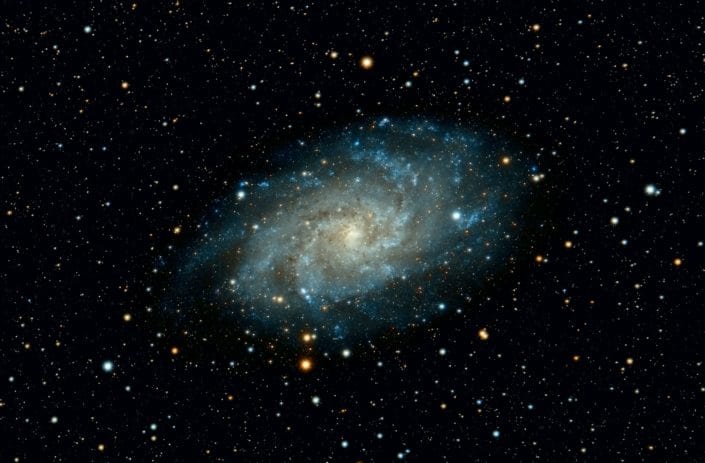
via: Unsplash / Guillermo Ferla
12. Is There Only One Universe?
So we've discussed the possibility of different realities above… but what about different universes? Are they the aforementioned affair?
At present… apparently, there are simply two overarching theories to this philosophical question… either we're in the only universe there is, or we're not (there are universes besides this one).
…And the one universe theory is pretty simple… our single universe exists, and it likely stretches on infinitely.
Now, this theory does accept one interesting quirk... since at that place are only then many ways particles can be bundled, in an infinite universe, the particles must echo at some bespeak, meaning billions of light years away, there's another World, and another you. source …Only on the other hand, you have multiverse theories, similar these:
Chimera Theory: unlike universes exist, but so far, we tin can only observe this ane. The other universes may be too many light years away to see, or they may have different laws of physics that prevent us from seeing them, or they may even be inside black holes.
Membrane (String) Theory: the unlike universes are 3-dimensional objects in a 4-dimensional universe, and they're stacked on top of each other, like the pages in a newspaper.
Many Worlds Theory: each thing that could ever happenhas in fact happened, and the universe 'splits' into another universe (or alternate timeline) each fourth dimension an action takes place.
…Now I go it:
These theories are incredibly complicated. Some scientists actually spend their whole lives trying to empathize these concepts. Just this video tin help explicate each theory above with helpful illustrations.
Which theory exercise you think is true?
xiii. Do the Needs of the Many Outweigh the Needs of the Few?
A thought experiment called The Trolley Problem has been used for years to visually demonstrate this question:
Imagine that a runaway train is on track to kill five railroad workers. You're standing next to a switch that tin re-route the train to a unlike track, saving the lives of five people. Simply here's the problem:
If you do re-route the railroad train, a unmarried worker on the new route will exist hit past the train.
…So the question becomes:
Is one expiry improve than five deaths? Or are they both equally bad?
And more importantly… are decisions (like whether or not to pull the switch) only morally right considering of the positive issue (saving 5 people)… or should nosotros take into accounthow we get to the upshot (murdering one person)?
If y'all believe in utilitarianism, then you'd answerno, it doesn't matter how we get to the issue. The greater good (living) was washed for the greatest number (five people).
…Only a believer in deontologist principles would say that since killing is always wrong, it'due south better to allow the train to run its form, rather than intentionally murder a person.
Here's the bottom line, guys:
You can focus on the outcome of the circumstance (v people saved vs. only one dead), or the action it took to get there (murdering a person). Which do you believe is more important?

via: Pexels / Snapwire
four Funny Philosophical Questions To Brand Them Think and Express mirth

via: Pexels / Djordje Petrovic
Philosophy is most often seen as a very serious discipline – merely there is a long tradition of smashing minds who found humor in the workings of the world. Having a few funny questions to ask that notwithstanding have a philosophical focus is a great way to keep the chat from becoming besides night or heavy.
Here are iv funny philosophical questions:
14. Do Animals Take Souls?
For this philosophical question, we're assuming that the 'soul' is the spiritual or immaterial office of a person that lives on after death… not another style to say 'mind' or 'consciousness' (considering most would agree that animals have those things).
So, is that kind of soul reserved for but humans?
Sure animals (especially pets) seem to accept feelings… we even think they feel love toward humans, and even other animals (mostly considering of their protective/affectionate actions toward the states, similar these).
Then, the deeper question to ask is… does the fact that they accept feelings, especially of love, mean they have souls?
How else could we detect if a creature has a soul, if it's not through the being of feelings like love?
…And do you have to detect a soul in a beast (animal or man) to know it exists? How practise we detect our own human being souls? If we tin't… do we even accept them?
15. Does Free Will Really Exist?
At present… I know what y'all're probably thinking:
"Of course I take costless will! I chose to read this commodity, didn't I?"
But the idea of free will isn't that elementary.
It's not but your ability to make everyday choices… it's questioning whether your actions/decisions are predetermined past a chain of events influencing your electric current state.
What does that mean? Here'due south an example to clear it up:
George is a canis familiaris-loving, pizza-hating accountant who recently decided to motility to New York.
Co-ordinate to the theory called causal determinism, everything well-nigh George's life has been pre-determined by cause and effect and previous occurrences completely out of George's control.
For example:
- Does George like dogs considering he grew upwardly with 1?
- Does he detest pizza considering it gave him terrible food poisoning as a kid?
- Did he written report accounting because an enthusiastic teacher sparked his involvement in numbers?
- Did he motility to New York considering his close friend already lived there?
Basically… did George actually decide annihilation about his current lifestyle and preferences... or was it all adamant for him past years and years of random circumstances?
…And then, here's the bigger, fifty-fifty more thought provoking question:
If that kind of crusade and consequence influences your every moment and determination, then do y'all really have costless volition?

via: Pexels / Kaique Rocha
16. How exercise youexplicate consciousness?
There'due south no doubtfulness that nosotros're witting (even if you believe that nosotros're conscious in a simulation).
Consciousness just means that while nosotros're moving through fourth dimension, we're aware that we move through it. A plant, on the other hand, doesn't seem enlightened that it moves through fourth dimension.
Now:
Consciousness is confusing for scientists because it doesn't fit into scientific explanations of the world… while physics explains how chemistry works, and chemistry explains how biology works, and biological science explains how psychology works, consciousness doesn't seem to fit in anywhere.
And information technology'south extremely difficult to test theories on consciousness… since science is objective, and everyone's consciousness is subjective, and those ideas conflict. But that hasn't stopped scientists and philosophers from developing theories, like the theory of pansychism.
Pansychismclaims that every arrangement has a level of consciousness (fifty-fifty downwardly to microbes and photons), and the more information the system can process, the more consciousness it has (so humans are more conscious than dogs, which are more conscious than plants, which are more conscious than photons... but everything is yet witting). source …And since everything in the universe has a level of consciousness, consciousness is as fundamental to the universe as fourth dimension, space and mass.
Make sense?
At present… what exercise you think most consciousness? Why are we conscious… and are all things conscious to a degree?
17. Why practise we dream?
It's been suggested that anybody has dreams source (the vivid pictures and sounds you feel in your sleep, not aspirations).
But… why?
The aboriginal cultures of the world almost all believed that dreams were sent from the gods, or were a connection to them (click hither to run into 7 of these extremely interesting ancient theories on dreams).
But more than modern theories try to connect dreaming to other things besides gods.
Here are 4 of those dream theories to explore:
- Freudian dream analysis. Dreams are your mind'south mode of fulfilling wishes, often using symbolism. For example, you lot desire to pass your final exam, so you dream virtually a coronation where yous're crowned a male monarch (and the crown symbolizes the passing grade).
- Contemporary Theory. Dreams are indicators of emotion, and the more than emotions nowadays, the less clear the dream is. For case, a trauma patient in the hospital dreams about being swept away by a tidal wave (the emotion of overwhelming, traumatic fear lead to a dream of an overwhelming, fearful state of affairs).
- Activation-synthesis hypothesis: dreams are the encephalon's endeavour to logically string together brain activity, just similar when you're awake. Your dreams are all 'casuistic' because your neurons keep to fire while you lot're asleep, and your brain is so driven to be logical that information technology tries to piece together a story/meaning of your random encephalon impulses.
- Parallel universe dream theory: dreams are portals into the lives of 'counterparts' that are created according to many worlds theory. For example, you dream about visiting a graveyard with your ex-landlord considering that's what a 'yous' in a parallel universe is doing.
…And in that location many more dream theories (hither are a few). After looking at all of them, why practise you think we dream?

via: Unsplash / Dyaa Eldin
6 Philosophical Questions to Inquire a Girl or Girlfriend
Having the right questions to ask a daughter can make the difference between getting to know each other on a deeper level, or remaining uncomplicated acquaintances.
Philosophical questions tin can make dandy opportunities for connection, and are some of the best deep questions to ask a girl. Or, if you lot're looking for deep questions to ask your girlfriend, these are guaranteed to give y'all a chance to connect on a deeper level with each other.
Here are six philosophical questions to enquire a daughter or girlfriend:
18. What, Exactly, Makes You… You?
You probably have an idea of what you define every bit your identity… what makes you yous, unique from everyone else.
For example, you might think your identity lies in your trunk, since your body is unique, and you control every movement of it… but since almost all of your private cells die and are replaced consistently, source would you desire to claim that your identity lies with those dead cells?
Probably not.
...Then so, your identity probablyrests in your personality, which is definitely unique to you… but here's the question that makes you think:
Did y'all create your personality? If information technology's genetic coding (nature), you didn't… your parents did. And if it'due south your environment (nurture), and so you didn't… everything in your life did. source I know it's confusing, and so here's an example of that concept:
Phil is an excellent lawn tennis histrion with a short temper who's really bad at writing. At present:
Is he proficient at tennis because he was born with the right genes… or is it because his dad forced him to practice for 3 hours every 24-hour interval as a child?
Does he take a short atmosphere because he'south neurologically wired that fashion… or because he constantly observed his mom's anger?
Is he bad at writing considering his encephalon favors math and science… or did he simply have bad grammer teachers as a kid?
In other words:
Did nature give Phil his personality, or was it other people/circumstances?
…And if outside circumstances defined who you are, is that how you want to place yourself?

via: Unsplash / Cristofer Jeschke
19. What is truth?
Now... I know this one seems obvious, if you look at the definition:
Truthis beingness aligned with facts or reality. source We all know that.
Only what I'thousand asking here is what is true? How tin we tell? And who decides what is true?
Take that last question... do each of us, individually, decide what is true? We all have different opinions on what is right (or true) in some things, such as what flavor of ice cream is the best... and we all know that what'struefor me might existfalsefor you (if my favorite is vanilla, and yours is chocolate, etc.).
On the other hand:
Is truth real exterior of individual people's heads (is at that place objective truth)? Can some things in the universe beabsolutely true,no affair who considers them?
...Or possibly the only 'truth' that we know for sure is that we exist (Descartes'southward famous decision that 'I think... therefore I am'). Everything else outside ofthat undeniable factcould be an illusion... then do nosotros know that anything else is 'true'?
PS. Here are a few more than (complex) theories of truth to assistance you consider this question.
20. What is beauty?
Dazzler is in the eye of the beholder.
…Or in other words, beauty is subjective. This means that each person defines what is beautiful to him or her, and things tin can be beautiful or non depending on who you enquire.
The show for this is that people unremarkably disagree about whether a person, place or thing is beautiful. Right?
Now:
On the other hand, beauty could be objective, meaning that whoever's looking at it (if anyone is), information technology'south still beautiful no matter what. There's really some evidence to back up this beauty is objective theory:
This examination explains how math tin make faces more beautiful (in the form of the Golden Ratio), and shows how 'beautiful' faces through history follow the same mathematical organization . That would make beauty universal and timeless.
…So what do you believe:
Is dazzler subjective (in the centre of the beholder) or objective (universal and timeless)?
Or is dazzler something else entirely, like a measure of usefulness (Aristotle idea this… that a poorly-made golden shield is less cute than a perfectly-fabricated toilet), source or merelyfamiliarity (like this survey, which shows people perceive familiar-sounding foreign languages as more beautiful than strange ones).
With all those theories... subjectivity, objectivity, usefulness, familiarity... what is beauty?

via: Pexels / Bruce Mars
21. Are Nosotros Obligated to Assistance Others?
Now, with the above question:
If humans do have rights, are nosotros responsible for making certain each human retains their rights? If then, when did we assume this responsibility for other human's rights? Why are nosotros not each responsible for just enforcing our own individual human rights?
Remember nigh those questions equally yous go on reading:
There are a couple of behavior that people can cull (like a code to live by), that tell them how to treat human being rights. For case:
The Gilt Rule states that you should practice for others exactly the things that you'd want them to do for you… and that that attitude of giving will hugely benefit our society.
Utilitarianism, on the other manus, states that the best activeness toward others is the 1 that makes the most sense for the greatest number.
Now… those two beliefscould overlap, but here's a powerful example of when they're highly unlike:
A tsunami is about to hit a crowded metropolis. People are running abroad from the embankment through the crowded streets, including you and your family.
...And right backside you, a man trips, falls, and starts to get defenseless under the feet of the people running by him. He'll be trampled to death in a few seconds.
Now… if yous're a laic in the Golden Dominion, you'd finish running, and you and your family would plow and help this human being. That's what you would want if y'all were him, right?
...But if y'all're a laic in utilitarianism, you'd probably think that risking your life, the lives of your family, and the lives of the people you'd inevitably slow down is not worth it to save the life of just 1 homo.
Can you encounter how each principle would dictate you deed in a different fashion?
…And then what exercise you believe about our responsibleness to help others? Practice nosotros follow the Aureate Dominion, utilitarian principles, or do we even take an obligation to help others? And if everyone believed like you lot did, how would information technology change our society?
22. Why Practice We Experience Emotion?
Emotions exist for almost all humans… but why do we take them?
Is it an evolutionary benefit? It can be argued that emotions like fear kept our ancestors alive, and emotions like joy made them want to mate.
But on the other hand, plants have existed/evolved for thousands of years, and even though they don't accept emotions, they've still survived. source And so… maybe emotions evolved from an evolutionary do good to a social ane. Think almost it:
We're extremely driven past society… we want powerful, benign relationships, and emotions motivate us toward those relationships (happiness around others motivates united states of america to stay around them, anger motivates us to leave a relationship, loneliness motivates the states toward relationships out of isolation). source Simply on the other hand, emotion can hurt us but as much every bit it can help us:
A study had subjects complete half of a examination, and so be told they'd either done excellently, poorly, or average compared to the contest… and in the second half, those with no emotional influence (the 'average' ones) performed better than both emotional groups. In other words, any emotional country hurt their power to perform well.
So, if emotion can hurt us just as easily as help u.s.… why practise we still experience emotion? Will nosotros eventually 'evolve past' emotion?

via: Unsplash / Tim Gouw
23. What Is Honey?
Dear was one of the about-debated philosophical topics among ancient philosophers... and even with a scientific understanding of how the brain processes love, it's still a philosophical question without an exact reply.
Hither are some philosophical theories on what dear is:
Aristophanes (Greek playwright around 400 BCE) source claimed that love is a pursuit of 'wholeness'… and even that humans were once iv-legged, four-armed, ii-faced creatures (like two humans sewn together), just later an act of Zeus carve up them in one-half, they long to be reconnected with their kind. source
…In other words, love is the pursuit of your missing half that was carve up autonomously from you. Information technology might sound silly with that visual example, just a lot of people notwithstanding believe that love is searching for your missing half… a soul mate.
Now:
Another Greek at the time, the philosopher Socrates, strongly disagreed with Aristophanes. He thought that dear is the way humans have evolved to 'live forever', because dearest for i some other causes people to have children, protect each other, provide for each other, etc. source
…And more than contempo scientists claim that love is simply chemistry:
Love releases dopamine and serotonin in the brain, and our brains choice dear mates for us based on whose chemical composition matches ours. source
But what practice you lot remember about love? Is it a search for your soul'south mate, a desire to keep our society going, or only a chemical attraction?
vii Philosophical And Idea Provoking Questions

via: Pexels / Spencer Selover
When y'all experience like waxing philosophical, these fascinating idea provoking questions get things moving. Covering deep topics such every bit existence, the heed, values, reason, language, and knowledge, these are the timeless questions that never become out of style, to say the least.
There are no easy answers to these questions. In fact, you may find yourself marinating on them well after the conversation has ended. Exercising your encephalon is an awesome way to develop your social skills while as well bettering yourself as a whole.
These questions are cocky-improvement tools as much as they're conversation topics. Pay attention to the answers, and proceed an open mind. Yous may find new points of view that can change your world for the better.
Hither are 7 of the best philosophical and thought provoking questions:
24. If the only thing I know is that I know nothing, practice I know something?
You can argue both sides for hours and notwithstanding not get anywhere/
25. Is the answer to this question no?
*Listen breaks*
26. If I get back in fourth dimension and kill my grandfather before he conceives my father, I take prevented my own conception. Then can I not go dorsum at all?
Time travel paradoxes are always fun, if your idea of fun is making your brain sad.
27. If I were omnipotent, could I create a rock then heavy I couldn't lift it?
If you accept the power to limit your power, are you really anointed?

via: Unsplash / Markus Spiske
28. If every cell in my body gets replaced over 7 years, will I still be me in vii years time?
If you lot replace every single component in a Ford with Chevy parts over time, is the finished vehicle a Ford or a Chevy?
29. If no one observes an upshot, did information technology happen?
Does the tree fall in the forest? The double-divide experiment may alter your mind.
xxx. Do villains consider themselves to exist heroes?
Are they self-aware and just fine with being evil?
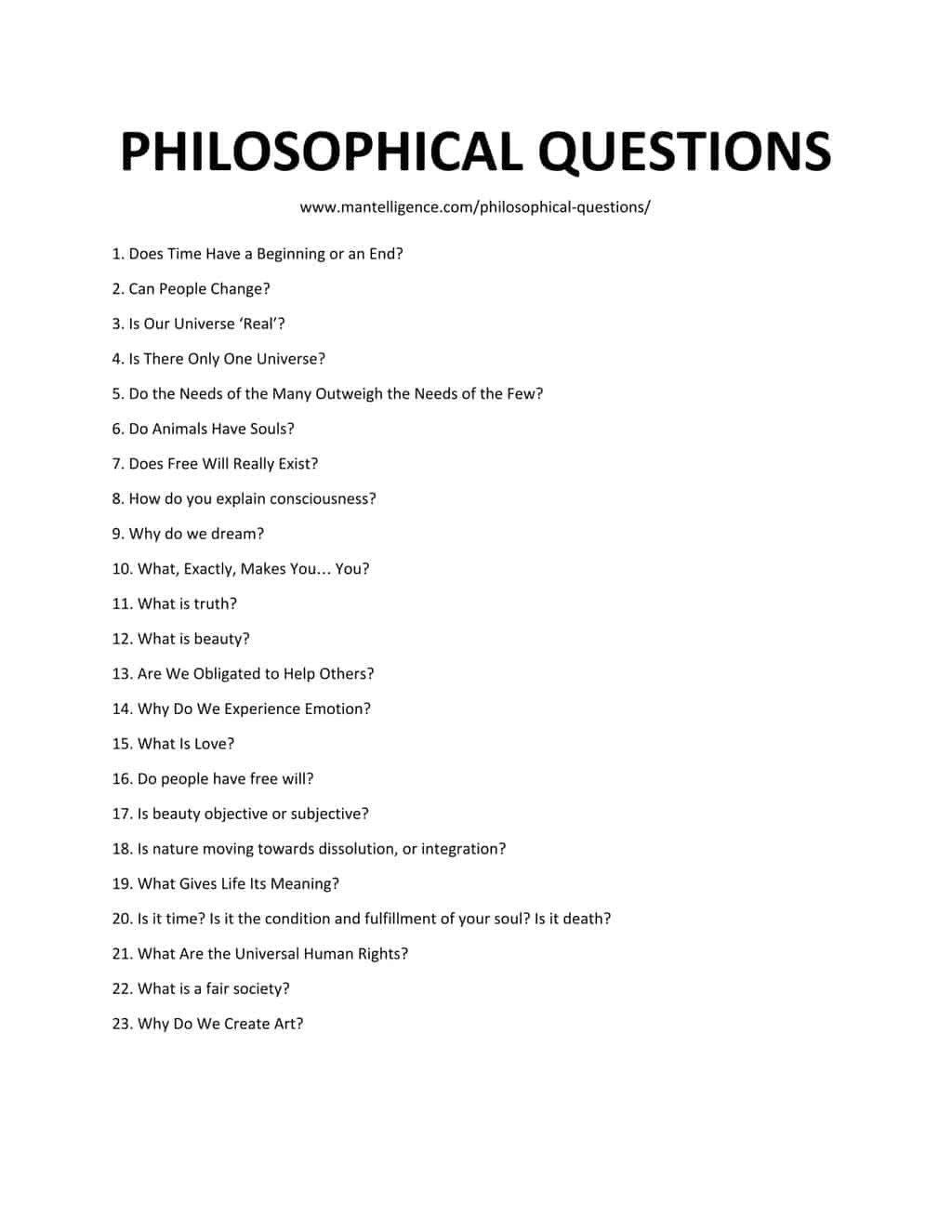
Downloadable and Printable List of Deep Philosophical Questions
Hither is a downloadable and printable listing of deep philosophical questions (correct click the image and select Save Image As...):
via: Mantelligence
Looking for More Philosophical Questions
Philosophy is a fascinating study that is both deep and wide, having been pondered by some of the greatest minds in history. If you liked these questions and desire more like them,we've got y'all covered:
- To take the conversation even deeper, look towards existential questions (and be prepared for an in-depth conversation).
- Before you break out the deep philosophy, you lot may want to innovate yourself with some become to know you questions.
- Looking for a more general list of questions? We accept questions to ask a guy every bit well as questions to ask a girl to get you started.
In Conclusion
These 19 thought provoking, philosophical questions aren't completely answered here (they were chosen considering they're questions to make you remember), to give y'all the room to call up or write about what you retrieve about each one.
...And by thinking deeply near each one, yous can keep the ancient tradition oftrying to understand humanity, immortality, and our universe.
Source: https://www.mantelligence.com/philosophical-questions/

Post a Comment for "30 Deep Philosophical Questions - Highly thought-provoking questions."