Changing My Own Oil and Filter
The line at the quick-lube goes around the building and about to the street. But the machine parts store parking lot is empty--now's your chance to show the married woman that it actually is cheaper and easier to alter your own oil. Especially later watching the grease-stained quick-lube mechanic through the bay doors for a couple of oil changes. Air wrenches on the oil-drain plug? Even though you realize that cars take inverse since yous got out of the addiction of changing your own, they haven't changed that much.
Jack It Up
Jacking up the front of the car and putting it on safety stands is still the start step, and placing the drain pan under the oil-drain plug is the 2nd. Okay, y'all're ready to loosen the plug, only it's really tight. That mechanic with his air wrench patently was the last one to tighten information technology. Drain plugs typically have a soft metal washer or a sealing washer with a prophylactic insert. Use a properly plumbing fixtures box wrench or a vi-point socket wrench to remove the plug. Be careful not to rock the socket to the side equally this could impairment the flats on the bolt.

If putting the car upward on stands doesn't leave y'all enough underbody infinite to get adequate leverage, y'all can utilize a 4-way lug wrench provided it has the proper end. This will allow you to twist the bolt without adding whatever side thrust, and yous'll be able to use both hands and all of your upper-trunk strength. Remain calm, have patience and yous'll become it loose.
Only of course, life isn't easy. The threads in the pan and on the plug are damaged, perhaps from fractional cantankerous-threading. What to practice now? Forget the bleed plug and become a repair kit. A typical kit has a replacement fitting that cuts deeper threads, and when tightened, it seals confronting a washer and remains in identify. Some kits cutting fresh, deeper threads for a new plug. A hexhead brass cap with an O-band seal threads onto the cease. When information technology's time to modify the oil, you unthread the cap. Others (for odd-size, severely damaged holes) are fatty, cone-shaped synthetic prophylactic plugs larger than the drain-plug pigsty. You force a special rod into an opening in the cone, which temporarily stretches it and reduces its diameter, allowing it to fit in the hole. Withdraw the rod, and the cone relaxes and seals the hole--the cone won't come out until you force in that rod to stretch it.
If the bleed plug looks marginal, consider installing a Fram oil-drain valve kit. These are bachelor for the most common types of bleed-plug holes. Thread a spring-loaded valve assembly with a copper washer into the hole and tighten. The valve is the primary oil seal, and a knurled cap threads on fingertight against an O-ring--this keeps out clay.
When it'due south fourth dimension to drain oil, unthread the cap and thread on a fitting with a drain hose, which you lot tin aim right into the pan (no splatter and no hot oil running downwardly your arm). The hose plumbing fixtures has an internal tip that pushes open up the spring-loaded valve, and the oil drains out. When the pan is drained, unthread the hose fitting (the valve springs shut), reinstall the fingertight cap and y'all're good to go (afterward changing the filter and putting fresh oil in the engine, of course). If the drain plug is okay and you want to reuse information technology, replace the washer and and then tighten the plug to specifications--xx ft.-lb. to mayhap 35 ft.-lb.--depending on the size of the plug.
Empty the drained oil into a suitable container. (In my area, the county gives away flat jugs with a behemothic born funnel.) When the jug is full, accept the oil to the store where you bought the new oil to be emptied into an oil-recycling tank. Many states require service stations to take small quantities of old oil. Dumping oil in that low spot backside the shed or into the sink is not acceptable--and probably is illegal where yous live.

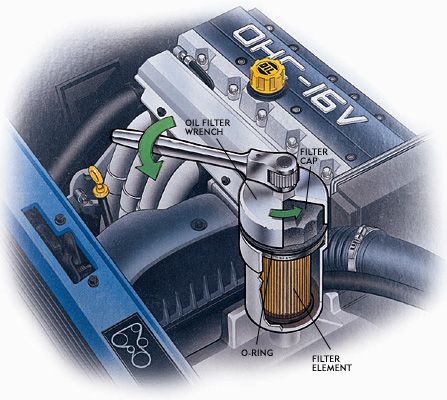
A elementary band wrench may be all that's necessary to remove a canister filter. Make sure y'all have enough room to swing the wrench.

A spider-way wrench may be more than suitable for filters that are non easily accessible.
Remove The Filter
When removing an oil filter, what you demand more than anything is the appropriate wrench. At that place are many sizes, and perhaps the most mutual reply is the cap wrench, which fits on the terminate of the filter. Merely problem: The wrench fits against a fluted pattern and there are endless fluted patterns. So not only do yous need the right size, but the right internal shape to fit the flutes. The 1 that fits the filter on your car now, we should warn you, may not fit the replacement filter you purchase.
Sometimes the end of a filter has a hexnut in the center, and then you could utilize a conventional wrench. If you tin can't notice the right size and shape cap wrench, try i of the following:
• Nylon ring wrench. This universal tool wraps a band around the filter tightly.
• Coil-leap wrench. It fits over the cease of the conventional spin-on filter, and the band coil extends to well-nigh the filter'due south base of operations. Plough the end with a wrench and the coils tighten around the unabridged filter. This prevents harm and separation from the base.
• Spring-band wrench. This wrench fits over the end of the filter and extends just past the flutes, so it grips the full circle of the filter trunk.
• A "spider" has 3 fluted legs that clamp against the spin-on cartridge and "dig in," preventing slippage. Information technology has an end plate for a ratchet, and because the spider legs extend 2-1/2 in., they grip well past the outer end of the filter. This design provides well-distributed gripping power.
It is possible to loosen a badly stuck filter with a expert filter wrench. How about driving a big screwdriver through the spin-on cartridge and using that to loosen a stuck filter? You lot're more probable to destroy the cartridge and however non loosen the filter.
Have the drain pan in place, sitting on a spread of newspapers or an oil-absorptive pad--but in case. Once the filter is loosened, oil may commencement flowing to the basis.
Unthread the filter and carefully empty it into the drain pan.
Refill the Oil
Use a film of clean engine oil to the gasket of the new filter, and so thread the filter on past hand. Some filters have a rubberized surface to brand it piece of cake to turn. Every reputable oil filter is designed to seal for tens of thousands of miles with no more a good hand-tightening. Y'all don't need a wrench unless you take one of those deeply recessed filters with no infinite around information technology for your hands. (If that'south the case, the only pick is a cap wrench.) Turn the filter until y'all experience the filter base merely make contact with its mounting plate. Then use the wrench to tighten a half-plow more.
If you haven't bought engine oil in a while, y'all may be confused past the choices. For a little friendly advice, see "What's That Starburst?" below.
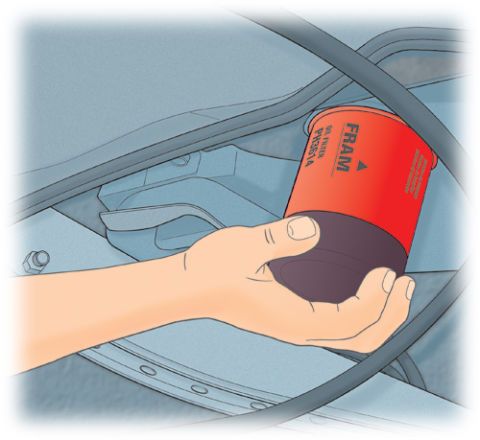
This filter has a rubberized surface area to provide for tightening past mitt.
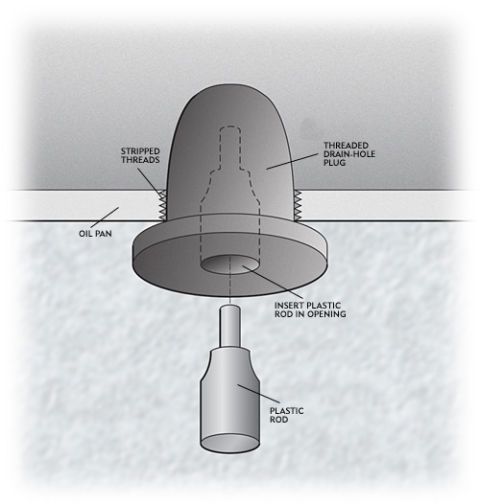
This simple prophylactic plug tin rescue a stripped-out oil-drain-plug hole. Insert the rod to install and remove it.
What'southward That Starburst?

You should encounter 2 labels on a container of oil. Ane is a "starburst" with the words American Petroleum Establish Certified printed on it. This ways that the oil has passed tests for the recommended service in which it'due south to exist used--that includes a exam by ISLAC (International Lubricant Standardization and Approval Committee). Passing the ISLAC oil test enables carmakers to add to their fuel economic system numbers. Oils such as 0W (a constructed form) and 5W (thin) pass this test, and and then do some 10W-30 oils. Heavier oils, including those formulated for older cars, practise non.
On the second label you'll run across the words "Energy Conserving." Real world: Oils labeled this way won't make a noticeable departure in your car's gas mileage. This label besides lists the service category. On tardily models you desire an oil designated For Service SL. Yous may also see some SL/SJ-rated oil on shelves. Read your owner's transmission.
This content is created and maintained by a third party, and imported onto this folio to help users provide their e-mail addresses. You may be able to find more data about this and similar content at piano.io
Source: https://www.popularmechanics.com/cars/how-to/a90/1272546/

Post a Comment for "Changing My Own Oil and Filter"